
Welcome to WordPress. This is your first post. Edit or delete it, then start writing!
Kicking the Sleeping Beast
Alright, I confess it: I’ve been in a bit of a funk after our rash of festival rejections. I’ve dropped the ball pretty hard on Two Bit Flicks, and it is time to get it together.
Wright Street has its flaws. Local film festivals with extremely limited screen-time allowances cannot justify 120-minute features from unknown talent, no matter how local, so our film is simply too big to get onto the program. Worse, we dedicate a bit too much effort to talk-y expository character development in the opening stretch, resulting in perhaps the most blatant cardinal sin against a great first impression – the first 30 minutes of our film are boring.
So we live, and we learn. I may eventually cut Wright Street down to an 80-85 minute “festival cut” to at least take advantage of our local festivals. There isn’t much I can do about our exposition without destroying the integrity of the film, so I have mixed feelings about it, but we’ll see.
But we did many, many things well with Wright Street. Our tiny crew accomplished heroic feats of creative problem-solving on practically no budget to capture a consistent, if a bit raw, canvas for the film. My cast whooped ass, impressing me to no end each and every (late, late) night with their talent, patience, and dedication to one crazy man’s hyper-ambitious goal of making a movie. And they did it all for nothing but pizza and a promise of credit. Their names belong on bigger screens than I can manage, but I can at least get their names onto your screen.
It is time to get Wright Street distributed. I have recently petitioned Kickstarter.com to list my project for public funding. My goal is to raise enough money to do a run of at least 1000 DVDs, which I can then distribute to you fine folks. The project isn’t live yet, but you can bet I’ll be keeping you in the loop as the project develops. Here’s what I plan to offer:
Project funding goal: $2000 [UPDATE: See the actual kickstarter project for true rewards]
– Supporters at the $10+ level will receive a copy of Wright Street, professionally printed, cased, and shrink wrapped
– Supporters at the $25 level will receive 2 copies of Wright Street, as well as a personalized, hand-written “thank you” note from one of our cast or crew
– Supporters at the $50 level will receive all $25-level rewards, as well as an official Two Bit Flicks T-shirt
– Supporters at the $100 level will receive all $50-level rewards, plus a deluxe, full-sized movie poster signed by as many cast/crew as I can manage
– Supporters at the $200+ level will receive all $100-level rewards, and will be credited as an “eternal supporter” in ALL future Two Bit Flicks productions
You will be receiving the current, full-length cut of Wright Street. This version of the film will not be reproduced after this Kickstart run, so it may become something of a collectors item. All subsequent re-cuts, re-prints, and re-releases of Wright Street will include the names of every Kickstarter supporter ($1+) in the end credits. Ironically, the DVD you receive for kickstarting Wright Street will be the only version that doesn’t include your name, but that should serve as proof that you were there on the front lines with us.
I intend to use all over-funding proceeds to recover some of the massive production costs of Wright Street (many of which I am still making monthly payments to pay down). These will go a great distance to help us repair our equipment and build up a nest egg to bring you newer, bigger, and better films from Two Bit Flicks. We learned a lot from Wright Street, and I’m looking forward to making another film to see how far you’ve helped us grow.
Anyway, I hope this news excites you as much as it does me. We made Wright Street in 2008. We finished it in 2010. Seems only consistent that 2012 is the year we release it to the world at large.
Thank you for your support, and stay tuned for links to the Kickstarter project page.
Cheers,
Mike
Two Bit Flicks joins the battle for Trailer Wars XVIII
Trailer Wars: Bellingham’s own amateur filmmaker free-for-all. The rules are simple: A theme is posted, and anyone who wishes to participate has roughly a month to create a trailer showcasing a would-be film in the appropriate genre. The event encourages all skill levels, backgrounds, budgets, and techniques. On the appointed day, all trailers come together to be shown on the big screen before a voting audience. The winner, among other accolades, names the theme for the next Trailer War, and the battle rages anew. It is free to participate, free to attend, and good times all around.
This month sounded the drums for Trailer Wars XVIII. The theme: No Human Actors. From there, you are free to interpret it as you wish. A romantic comedy starring GI Joe action figures? An animated murder mystery? Puppets in space? Stop-motion claymation super nova? Your call.
This is a fantastic event to promote the local film community, and it was only a matter of time before Two Bit Flicks had to jump on the bandwagon and weigh in with our support for the Bellingham film scene. So without further ado, we present our entry to Trailer Wars XVIII:
For the record, we did not emerge with the victory for the night. That honor went to the sleek & deadly Ninja Cat. Still, we had a blast and have joined the ranks of a very cool echelon. This will not be our last battle in the epic Trailer Wars.
More Goodies for You
– Trailer Wars YouTube Channel: A nearly complete collection of all Trailer Wars entries, grouped into playlists according to the theme of the event. Hours of entertainment await.
– Trailer Wars on Facebook: Become a fan and get the latest updates, invites, and videos.
– Where’s Waldo: The debut film effort from one of Two Bit’s greatest supporters, which also appeared in TWXVIII.
Discussion Topic: Next month’s theme is “Direct to DVD Sequels”. We have until roughly mid-June to put something together. I’d love to hear your ideas. Further, if you’re interested in working with us to put this (or any project) together, just let me know: mike@twobitflicks.com
Cheers!
Idle Curtains Part 3/3: The Next Step
Greetings, and welcome to the third and final installment of our adventure to begin an adventure (See the first two installments here and here). We have witnessed WRIGHT STREET’s festival rejection ballet, and have explored much of the reasoning behind this dance of disappointment. As much as it pains me to boil all of our hard work over the last few years into the following statement, it is a simple truth: We fell down.
So now it’s time to pick ourselves up again.
On one hand, WRIGHT STREET was a smashing success. We set out to mobilize some creative energy and prove to ourselves that making a feature film was well within our grasp. Some of those involved in the process have carried that momentum into other projects, and every future success more than justifies what we’ve done here. However, we also must acknowledge the other hand, which is presently patting us on the head and turning us away. If WRIGHT STREET is a lesson-learning vehicle, then we haven’t finished finals week until we get a public screening.
Based on the feedback posted earlier, it becomes clear that WRIGHT STREET suffers from two fatal flaws:
- Clocking in at 1:59:50, it is simply way too long for a festival slot from an unknown source. Most festivals have a narrow programming schedule, and receive many more applications than time permits. Even festivals with home-field advantage are frequently forced to lump all local acts into a single ticket slot, and there is no way a 2-hour beast will make the cut.
- With a ton of tell-don’t-show character development weighing down the opening stretch of WRIGHT STREET, we come out of the gates to, well…bore you. While most critics agree that the film eventually gets pretty engaging, the dragging first half is a nail in our coffin. Especially in terms of an unknown cast/crew, the opening is the most important time you’ll ever have, as it sets the tone for the level of attention your film deserves. It would be perhaps forgivable if our flick started exciting and gradually lost steam. As it stands, today’s busy audience would have already wandered to the next show before we got around to giving them a reason to stay.
While there are a handful of other very valid criticisms, if we can overcome these two faults, we’d have ourselves a contender. So here’s the plan:
1) I am currently working on a revised cut of WRIGHT STREET that will clock in between 75-80 minutes. This is a much more reasonable runtime, and will involve dropping much of the grinding of the first half. When all is said and done, what we sacrifice in terms of explicit development and a few fun scenes we will more than recover in momentum and impact.
2) I have started to work with Wilson Large, the force behind Bellingham’s NW Projections Film Festival and a great resource to help us get the film publicly screened through his involvement with The Pickford Film Center. With Wilson’s help and the two cuts of WRIGHT STREET, I am confident that we can get the film into a solid final cut and launch it to the public very soon.
3) I am currently working on a complete write-up of WRIGHT STREET, a sort of manual that details what we did along every step of the entire process and the lessons we’ve learned along the way – From our first mention of the screenplay, through our dreadfully neglected preproduction phase, casting, in-depth production notes, editing, post, and more, to hopefully conclude with our successful public release. All of this will be available through our website, along with complete stream-able copies of each full WRIGHT STREET cut, so that you can follow along and learn about the bumpy first steps of independent filmmaking.
Regardless of whether our final tally chalks WRIGHT STREET up as a fail or a win, it remains an epic adventure. We’ve learned so much, and thanks to your continued feedback and support, we are continuing to develop. It is my hope that, by making these resources available to you, we are able to give you something of value in return. WRIGHT STREET is about learning the ropes and conquering the impossible. We’ll be giving you full access in the hopes that you can do the same.
Stay tuned, and as always: Thanks for watching!
Idle Curtains Part 2/3: March of the Critics
Welcome back, friends. If you’re following this series, then you know that WRIGHT STREET has seen a fair share of upsets on its way to a theater near you (if you’re just dropping in, catch up with Part One here). Filmmaking is an extremely involved process, with a great many elements that must be juggled together on the tightrope of a good story. But even the most death-defying circus feats are only as strong as the applause that follows. It is easy to get lost in the mechanics of it all; to swell with pride over the success of a million tiny pieces only to lose sight of the bigger picture. After our deluge of festival rejection letters, it was time for a hard look in the mirror.
Enter the critics. Armed with ink pens, tiny flashlights, and the vastly influential star-rating system, they represent the voice of the audience. Sometimes they paraphrase the essence of a film so brilliantly that we see a depth beyond even what the filmmakers had intended, while at others they wield such scathing venom as to make a film the cautionary tale of the ages. It can be tempting to dismiss a review as the subjective and therefore irrelevant ravings of a glorified film buff, but to do so is foolish. At their core, critics are folks who know the medium well enough to articulate what works and what doesn’t, and collectively provide a solid objective assessment of a work. In truth, the odds of a filmmaker garnering a positive review are proportional to the attention we pay to the negative ones.
In that spirit, we present the first critical reviews of WRIGHT STREET:
1) Henry Darrow McCommas of Crooked Lake Productions: Henry is a working filmmaker operating out of Seattle, and we were honored to have him attend WRIGHT STREET’s private premiere last September. As someone who had already gone through the process with which we are currently grappling, his insight is most appreciated. While not a review in the traditional sense, Henry was kind enough to plug our film in his blog, and as our first bit of outside press, it was cool to see how someone else put our movie into words:
Nightmare on Wright Street
Posted September 24, 2010
Americans live in a complicated time where battles fought in different countries feel like different worlds. The barrier between communication and comprehension is large; propaganda is displayed repetitively to create fear and embed symbolic images into your head through out the day. When you get the chance to break away from the work force and SUV your way back home there should be one thing on your mind- relaxation. Your neighborhood provides security packaged in a comfortable, nostalgic type wrapping. Just when you think you might want something more than the suburban lifestyle (a spoon full of adventure with your dose of two creams and three sugars) darkness moves in.
What do you get when you take the intensity of Wes Craven’s “Last House on the Left” and mix it into the cookie cutter neighborhood of Joe Dante’s “the Burbs?” “Wright Street,” an independent feature produced in Bellingham by Washington’s up and coming creative team, Mike Watne, Royce Clemens and Joel O’Connor.
Producer and actor Joel O’Connor says, “Wright Street is an examination of suburban living and how it can be thrown into chaos when someone unwelcome moves into town. The story touches upon themes of justice, retribution, vigilantism, trust, self-worth and deception. Mike Watne was tired of all of his friends and colleagues talking about that mythical “some day” when he would direct his own feature film and decided to turn that “some day” into today. He called upon the writing talents of Royce Clemens and asked me to be the producer. I said ‘hell yes’ and quickly reminded him of my acting talents too.”
Editor’s note: I had a chance to read some of Joel’s work a while back and quickly became a fan. He has always been supportive of Crooked Lake and creative people, so getting the chance to see one of his projects is exciting.
2) The Zero Film Festival: These guys are a real class act. As testament to their mission to champion the cause of the self-financed film, the ZFF includes an option for every submission to receive a detailed critical analysis from the programming team that explains exactly why a work was accepted or rejected. It is a constructive-feedback goldmine directly from the people with the power to get your film on the screen, and I strongly recommend it to any aspiring festival candidate.
WARNING: MAJOR SPOILERS!! If you haven’t yet seen the film, you may want to leave this post now and come back later.
Wright Street–‐Review
It is always challenging to begin a review of a film such as Wright Street. At the Zero Film Festival, we have many entries from amateur filmmakers entering feature films that obviously were written in a week or less and that have no business being a feature film. Wright Street is the opposite of this–‐it is the type of film Zero Film Festival was created to support–‐a feature film with a well–‐written script and devised plot–‐written and shot within the parameters of an authentically independent film. This review will focus on a couple of points to improve further work
There were a few issues with sound, early in the film synching was off with the dialogue in the table discussion scene where we learn about Michele. In the first half of the film as a viewer I felt trapped and manipulated by the soundtrack. While excellently played later in the film–‐especially during the plot to murder Pam–‐the initial conventional soundtrack manipulations were especially blatant and disconnected me from the viewing experience.
Lighting–‐this was one area where Wright Street upon screening appeared to have been disregarded–‐especially challenging moments were the weak lighting in the “Man Shack” scene (although this was where more engaging camera work was thankfully introduced)–‐ and it was only upon viewing the bonus features that we realized a lighting kit had been used throughout the film.
In the beginning we would have liked to have seen more of the characters, letting actions speak for the character–‐the maxim “show don’t tell” especially resonates with the first third of Wright Street. There was great effort to “Greek” out a lot of the logos in the film, but there was a Nike logo apparent early in the film–‐and for this reason alone we would not be able to program the film for risk of lawsuits–‐a dark reality of the film festival world–‐ and despite E&O insurance and liability waivers–‐these are risks we are not willing to take.
There were a few especially challenging moments in the plot. The imagery was brutal at 32 minutes in a good way–‐but the plot leap was a bit hard to take, namely, the car appearing in the garage, and while revealed in the ending of the film, the decision for the protagonist to so swiftly and willingly become an accomplice and whole–‐heartedly commit the character to the action. Rich’s suicide is hard to feel compassion for, the dialogue in the garage with his wife was stilted and hard to believe.
Was the Russian book a clever mis–‐en–‐scene? I would like to think that it was.
There were several moments in the film that really stood out in a positive way. The vigilante wild west dialogue was an excellent use of foreshadowing. I loved the joke with the orgasm/foot massage–‐the programming committee all laughed at that joke. I also really enjoyed the plot twist with the boss–‐clever play on a common cliché within independent films–‐and that it was also the director’s Tarantino moment made it especially rewarding. At minute 42 Wright Street was exceptionally powerful, and is a key moment where the Show Don’t Tell becomes potent and you really nail the cinematic language on the head. The bedroom scene where the wife confronts protagonist over his smoking offered a great use of dialogue, and a great performance. Way to gather receipts! 1:33–‐beautiful shot–‐ spin around the room…wake up with his wife–‐so cleverly done. 1:35–‐that was beautiful…well done–‐music, image, plot–‐raised my nerves and set up perfectly for the reversal when Carla attacks–‐ one of the best moments of the film. Loved the last shot. Anticipating cliché scream and instead the satisfying delivery of the dropped the water glass.
Ultimately–‐Wright Street is a film that improves dramatically in each of its thirds. The weakest was unfortunately the first third. More interesting or engaging shots–‐a focus on divulging character outside of dialogue, special focus on story or plot devices and a focused attention to technical detail–‐all of these factors, had they been applied to the first third as we had seen them done in later stages, could have raised the overall quality of the film dramatically–‐perhaps even making Wright Street an excellent programming choice for the Zero Film Festival.
3) Peter Bowse, independent critic and film scholar: The most important vote of all is the one that comes from the direct audience – the person who has no public or commercial incentive behind your project; the guy who just dropped a few bucks in the hopes that you’ll entertain him for a while, and who won’t hesitate to give it to you straight if you drop the ball. Granted, I gave Peter a freebie, but we still claimed two hours of his life that’ll never return, and here’s what he had to say about it:
WARNING: MAJOR SPOILERS!! If you haven’t yet seen the film, you may want to leave this post now and come back later.
My Thoughts on Wright Street
So, I watched Wright Street and wanted to give you my critique of what I saw. Now, I am approaching this much the same way we critique our films in classes here at Columbia, the main difference being I will focus more on story/script and directing aspects rather than the technical side (I’m sure you already know what I would tell you). That being said, please don’t take any of my comments as condescension; I am still learning about myself as a filmmaker, and critiques like these help me as well.
So, Wright Street. There are a lot of really good elements to this film. One of the best scenes is when Rich confesses to Ed his despair over the killing. Rich’s emotion really showed through and it was well written.
The scene in Artie’s garden had great color. I found it a great visual motif, the color of the garden contrasting with Artie’s black-and-white worldview. I wanted to see more of this throughout the film, returning to that garden.
Continuing with that, the best element of the film was the subtext: Rich and Artie (beer-drinkers, history buffs, John Wayne fans) are “real” men while Ed is a nerd or pussy. This was well-established in the beginning and their goading of him worked well. I would have liked to see this emphasized more, and more through showing than telling. What are some character traits about Ed which make him a “pussy” that you can show? After the killing, Ed picks up smoking, which is a clear example of this: he is picking up a character trait from Artie that makes him more of a man. However, I would have liked to see this more, rather than just have the conversation with the wife about the pack of cigarettes. That scene can still work, but it needs to be seen and developed more in order to be truly effective.
The biggest problem I had with the film has to do with genre. Now, subverting genre is fine and can work, but I have come to believe any first-time filmmaker (myself included) should recognize the genre they are working with and try to stay within that boundary. So, for example, is the film thriller? A drama? Horror?
The problem I see with Wright Street is that it tries to do too much; there are easily two – possibly three – different films within this one. Is the story about them killing Patton Jessup? If so, there needs to be more build-up. Yes, they kill his cat, but the jump to them killing Patton is a little too sudden. There needs to be more conflict to lead up to the kidnapping/killing.
Or is the film about the aftermath? The personal struggles after committing this deed? If so, the killing happens at the 45-minute mark, which is far too late (although if it were about that you probably wouldn’t even need to show the killing to begin with).
Toward the end it develops more of a mystery/thriller with Carla, which seemed a little jumbled. It’s a good plot, but it needs a lot of cleaning up. Also, I wasn’t entirely sure why Carla was trying to commit suicide if she came back to avenge her father (unless that was just a ruse).
For Ed, I found his character well-established during the beginning, but toward the end I wasn’t sure what his motivations were. At times he seemed to be taking control, but at other times he was being controlled by Artie. What if at the end it was Ed organizing Carla’s death and Artie was unsure, reversing the roles earlier in the film? At his death, I wasn’t sure why he was so glad he participated in the killing. What if he denied any wrongdoing, claiming to be a victim himself? These are just thoughts, but the point is that his character needs logical motivation and personality that flows from what we see on screen.
So far, this has mainly been from a writing standpoint, but as a director it is important to focus on the story itself just as much as how you plan to tell it. As directors, it is you and I who people will look to and blame/exalt over a poor/excellent script, whether we wrote it or not (unless you’re directing an Aaron Sorkin script, but that’s one of the few exceptions).
The black and white flashback scene of Ed burying Patton is very well shot. Good lighting, great mood. It feels a little too long, but that’s just me.
The scene of Ed and his wife in bed, where you zoom in and zoom out, is a really neat idea. However, I would always avoid zooms and pans at all possible. If you want to zoom or move the camera, dolly that shit. It looks and feels better, and for zoom ins it is more intimate. Don’t be afraid to get the camera right in the face of the actors; that’s what they’re there for.
Also, in relation to this scene, production design and framing are vital to a director. In that bedroom scene you have the edge of a picture frame and a lamp creeping in, but they serve no purpose but to distract. In other scenes, there is a table with flowers or other objects sitting in the foreground, while the action occurs in the background. Unless it serves a purpose, it shouldn’t be there. In Limerence, I unwittingly had a beer bottle sitting on a table in front of my camera. Being my first film, we had the camera focused more on the bottle than my character, making him blurrier than he should have been.
My biggest suggestion is this: Close-ups! I loved the scene with Ed and Carla playing the drinking game and talking, but it all took place from a wide shot. I wanted to move in and see that conversation, to be part of it. Always do close-ups, unless there is a specific reason for not doing them (wide shots give a distancing effect). Likewise, Rich’s “breakdown” scene I mentioned earlier is another example; the audience needs to see that emotion on his face.
Now, a common tendency is to show action occurring through wide shots, and many people focus too much on getting those wide shots first. For most scenes, however, close-ups come first (especially emotional scenes, because actors will get tired after multiple takes), then pull back. If you haven’t seen the recent film Monsters, watch it. The close-ups of the two actors at the end (and throughout the film) and their performances should be studied in film schools, they are that brilliant.
Action scenes should be planned out, and you should develop how you want to shoot it. A similar genre film I saw recently is The Square (neo-noir crime film). Watch it, if you haven’t. The director really knows his shit and his shots are perfect. Or, look at a director like Luis Bunuel. He never planned out camera shots until he got on set (not a good idea, but he was a genius), but his camera movements are fascinating and keep things from getting boring.
The last piece of advice I can think of is probably the most important for your next film (which I hope you make): film is collaboration; don’t go it alone. I noticed you edited and helped with cinematography. Unless you’re Gareth Edwards, don’t do this. I’ve found directors of photography on Craigslist, and if you’re anywhere near an art school you will be able to find someone to do it for free. A director should have someone to worry about lighting and framing his/her specific vision; they will help reduce clutter in the scene and any extra input is valuable.
Same thing holds true for editors. Wright Street is nearly two hours long, but for a first time feature that is not necessary. Efficiency is key, and editors can help trim the fat, so to speak, and it’s one less thing you’ll have to worry about. Again, try Craigslist, or network with the nearest art school. If you’re going to spend money on a film, lighting, sound and editing should be what most of the money goes to. You can also find fairly professional actors on Craigslist, and there are numerous other acting websites you can easily use, too. I feel like I’ve said too much, so I won’t go touch on acting save to say, find people whose career is acting. Even if they are just waiters/waitresses on the side, good actors will consider themselves actors first and foremost.
I hope I haven’t bored you, and if you’ve made it this far I appreciate it. I did enjoy Wright Street; it was entertaining and it showed a great deal of promise. I hope you plan on shooting something in the future, and maybe we can even collaborate on something down the road.
Thanks again, and good luck!
Peter
The people have spoken. To find out whether or not they were heard, drop in on the third installment of this little saga.
Oh, and if you have any critical insights about WRIGHT STREET that you would like to share, shoot me an email with your review to mike@twobitflicks.com. I’d love to hear what you have to say!
Idle Curtains Part 1/3: The Anatomy of a Rejection Letter
Well here we are, friends. Nearly three years after we began the monumental task of our self-financed feature WRIGHT STREET, we still have yet to honor our IMDB listing with an official release date. So, for those of you who are wondering when you’ll finally be able to get your hands on a copy of the film, and for the rest of you who may be curious as to the processes involved in getting an independent film before your audience, I invite you to share in a segment of our adventure to secure that most coveted of cinematic punctuations: The release date.
Our first objective was to obtain a screening as part of a film festival. What better way to reach an audience hungry for new ideas and rising talents? We knew that our goal was ambitious, but as with all worthwhile struggles, we set our sights high and hoped to hit a worthy mark on the way back home. Ready, aim…
1) Sundance: Few marks are higher in the independent film world than Sundance. While it takes a certain degree of audacity to expect a virginal effort like WRIGHT STREET to garner such acclaim out of the gate, I think it is important for any artist to develop humility through experience, and never to submit to it out of fear. Therefore, Sundance was the first festival to get the opportunity to tell us where we stood:
RE: 8003-UNF- Wright Street
Dear Mike,
On behalf of our Programming staff, I would like to thank you for submitting your film to the 2010 Sundance Film Festival. Unfortunately, we are not able to include it in our program this year. We received a record 9,800 submissions this year, and many tough decisions had to be made in order to narrow the field down to under 200 films. Please know that your work was carefully considered by our team, and we viewed far more worthy films than we had room for in the program. I sincerely hope that this decision does not discourage you in any way. We wish you the best of luck with your film, and we look forward to having the opportunity to view your work in the future.
Sincerely,
John Cooper
Director, Sundance Film Festival
2) Slamdance: For a film like WRIGHT STREET, a rejection letter from Sundance is anything but unexpected. A much more likely candidate is Slamdance, which runs concurrent with Sundance to champion the truly independent films strong enough to benefit from a bit of the limelight. At this point, we begin playing for some marbles on our quest to ascertain the fate of our mighty venture. The verdict?
Dear Filmmaker,
Thank you so much for your submission to the Slamdance Film Festival. We are sorry to tell you that we were unable to include your film in our 2011 program. We have limited time and space and are forced to select less than 100 films total. This year, Slamdance set a new record for submissions, receiving just over 5,000, so there were many many films that we loved but were unable to program.
We want to salute each and every one of you for not only submitting, but for making films. You know how difficult it is to get a film made. So do we. Slamdance is by filmmakers, for filmmakers, and we feel that all of you deserve recognition for having the grit, energy, and guts necessary to complete any kind of film. That is why each film is judged on its own merits, regardless of the names involved or any connections. Our commitment to that integrity, a filmmaker’s integrity, resulted in many long hours, late-night discussions, and agonizing decisions made in the process of putting together our program.
Please keep in mind that Slamdance is just one festival out of hundreds. Our film program is based on the subjective decisions of the members of our programming committees. Please don’t take this notice as any indication of the quality of your film or its potential for a successful, well-regarded future. There are numerous films that we saw that will have long and healthy lives on the festival circuit. We wish the best for you and your film and look forward to seeing more of your work. We have selected the work of many filmmakers who were not selected in previous years. Every year is different, and we appreciate your ongoing support for the Slamdance Film Festival.
Warm regards,
Slamdance Programming Department
3) Seattle International Film Festival: Slamdance was a bummer, but not a tremendous blow. We simply learned that we were not among the cream of the crop of this year’s independent offerings. Nothing shocking there. But if we didn’t have the chops to compete at the national level, the time had come to see how we fared in our own region. Enter SIFF, to which we had pinned no small amount of hope, for in spite of the fact that it happens to be one of the largest film festivals in the United States, it also makes a point to highlight films that hail from Washington State. Here, we had something on the line. And:
Dear Mike Watne
Thank you for sending Wright Street to the 37th Seattle International Film Festival. We appreciate you taking the time and energy to send your film to us for consideration. Regretfully, we did not select Wright Street to be presented at this year’s edition.
Every year, the quality of submitted films increases, and our decision is harder. We recognize that the selection process is subjective and is not a reflection on the quality of your work. Over three thousand films were submitted to us this year, a clear indication that the ability of filmmakers to get their vision to the screen is still thriving. In our quest to bring Seattle audiences a diverse and compelling line-up we view and seriously consider every submission. The very talented work of Seattle filmmakers was definitely on show this year, and though we try to show many works by local filmmakers, we are simply not able to screen them all. It gives us great faith in the work being produced here, and the level of quality that has been submitted.
The volume of entries received does not permit us to comment at length about your film. We were very impressed with the quality of submissions this year, and we certainly recognize that without the determination of independent filmmakers, SIFF would not exist.
We wish you the best of luck with Wright Street, and we hope you keep us in mind with your next project.
Kind regards
Carl Spence
Artistic Director
Beth Barrett
Director of Programming
4) Boulder International Film Festival: I’m not going to lie: That one hurt a bit. Feeling the pressure now, our next plan was to submit to a fresh, new festival that has been making waves; something big enough to draw some press but small enough to remain open to a hard indie like WRIGHT STREET. Here’s what BIFF had to tell us:
Hello,
Thank you for letting us consider your film for the Boulder International Film Festival. We regret that it did not fit into the program this year.
There were many good films that we were unable to include and we had to make many hard decisions.
We wish you every success with your film and all of your future projects.
Best regards,
Boulder International Film Festival
Programming Team
5) The Zero Film Festival: At this point in our story, it becomes clear that we’re going to need to be a bit more strategic in our festival submissions. We’re going to need a place that caters to the self-financed feature; a champion for the brand of willpower that sees a project like WRIGHT STREET come into its own. No festival on the circuit better embodies that ideal than the Zero Film Festival. Here goes nothing (and everything!):
Dear Filmmaker,
While we regret to inform you that we are unable to program your film for this year’s festival, we wanted to thank you for the honor and opportunity to consider your work. In a perfect world we would have the budget and venue space to screen every film we want, but unfortunately it is not the case.
The number one reason most films are not programmed is run-time. Cutting all the fat from a film makes it much more programmable. A lot of filmmakers make the mistake of keeping a 15 min runtime for a film that would work best at 5 mins, or hold onto a 120 minute feature when a 75 min. runtime would make an excellent and programmable film. We politely suggest taking another look at your film, and seeing if a re-edit would not help the film.
In regards to Written Reviews/Feedback- if you opted for this you will receive your review if you have not already. We are handling these one at a time, and so it is on its way shortly. While offering us your patience and understanding is probably the last thing on your mind, we would greatly appreciate it.
We wanted to take this opportunity to invite you out to a screening of your choice at this year’s festival. Please send an e-mail to info@zerofilmfest.com with GUEST LIST in the subject line and the program you are interested in attending and we will add you to the list.
And as always, we like to encourage you to prove us wrong. Nothing would make us happier than to see your film premiere at Cannes or Toronto. Good luck, and do not quit! Careers in films are marathons not sprints.
Thank you again for the honor of considering your hard work.
Best regards,
Team Zero
6) NW Projections Film Festival: If prayer is the last refuge of the scoundrel, then home represents the last great hope of any adventure. Surely, if we had any chance of getting our little film up before a festival audience, our best bet would be our very own hometown hero, Bellingham’s NW Projections Film Festival. What better mutual benefit than a screening in the very place our film was made? Lights, camera…
Greetings,
As Director of NW Projections Film Festival I want to personally thank you for allowing us to consider your film for the 2011 NW Projections Film Festival. This has been a great year for submissions and we enjoyed reviewing your film. We would like to have been able to select your film this year, and hope that you will continue to share your work with us in the future. If you need any more personal feedback or notes on your film I would be happy to provide them.
All the best!
Wilson Large
NW Projections Film Festival Director
And now we know: As it stands, WRIGHT STREET is simply not festival material. But why not? This very important question will be explored in the next installment of this series as we examine some of WRIGHT STREET’s first truly objective critical reviews. Enjoy!
Wright Street’s first bit of press!
Check out our very first write-up, by Seattle-based filmmaker and indie-guru Henry McComas.
Read it here!
A big thanks to Henry for taking the time to spread the word.
Some Fun Stuff
Our friends Henry McComas and Royce Sutherland at henrymccomas.com are launching a new web comic highlighting the ups, downs, and otherwise ridiculous moments that round out the filmmaking experience. Check out their debut strip:

(Original posting (with nice zoom functionality) appears here.)
For more installments, drop by Henry’s site and subscribe. Enjoy!
Wright Street Posters Are Here!
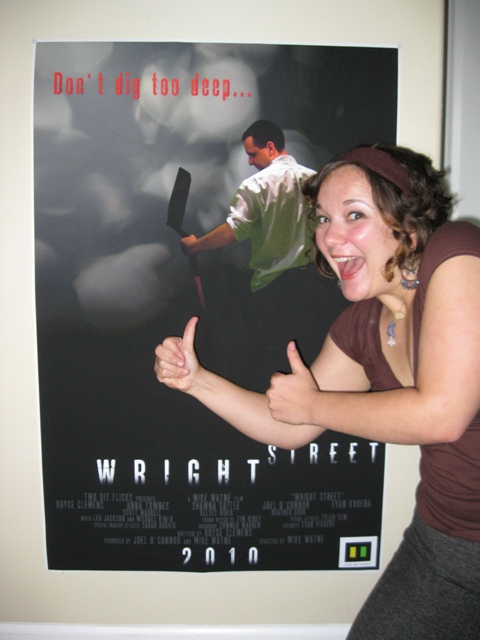
The new posters are in, and they look great. A big “Thank you!” to the fine folks at Copies Now.
Full Size: 27″x41″
Sexy Matte Finish
You can bet that these babies will be available on the web store soon. We’ve got the new shopping cart plug-ins almost configured, and we hope to get the new features launched within the month. Stay tuned.
A Big Update
Greetings friends!
Things have been very busy at Two Bit Flicks lately. We’ve finally finished Wright Street! And with that, comes the next big phase in its life cycle: Bringing it to a screen near you. Here are just some of the many things going on right now:
Wright Street on the Big Screen
Two Bit Flicks has teamed up with Bellingham’s premiere local cinema, The Pickford, to bring Wright Street quite literally to a theater near you! We’ll be hosting a private, invite-only screening on Thursday, September 23, 2010 from 9:00 PM to Midnight. Unfortunately, the exclusivity is important so that we do not blow any of our upcoming film festival entrance requirements. However, once we get the green light, we plan to begin ticketed showings on a reasonably regular basis. If you’d like more information about the private event, including a shot at one of the remaining seats, please send us a message.
Wright Street on the Web
 IMDb: We’ve updated the Wright Street listing with the remixed trailer, official poster, and all major cast/crew credits
 Facebook: “Like” us to stay connected with all of our upcoming events and goodies.
We have quite a few other web and social networking outlets, including Myspace, Twitter, YouTube channels, Digg, and more. We are gradually working to keep these resources updated, and any suggestions you may have to streamline your online Two Bit Flicks experience are completely welcome.
Film Festivals
We’ve submitted Wright Street to a handful of upcoming film festivals. We won’t know our acceptance status for quite a while, but any buzz we can generate between now and the selection process can only do us good. Here’s where we hope to be seen:
 Seattle International Film Festival: Our local A-list festival. We’ll be up against some major players with major dollars, but we have the advantage of being made in the area – a quality that the festival genuinely tries to encourage.
 Zero Film Festival: A festival catering to self-financed films, it is right up our alley. With events in New York, Los Angeles, and Miami, in addition to a select group of touring cities, this festival gives an enormous exposure push to any film selected to screen there.
 Boulder International Film Festival: Voted one of the 25 “coolest new festivals” (Film Maker Magazine), we hope it is a great venue for Two Bit’s own cool new production.
.
.
 Slamdance: Sundance’s independent counter festival, Slamdance invades Park City,, UT concurrent with the bigger festival to ensure all walks of film are represented. Another great way to be seen.
We have quite a few other festivals to which we plan to submit as well, but premiere requirements can be strict, so we’ll work in batches. If you know of any particular festivals, including anything in your hometown, where you’d love to see Wright Street, please let us know!
Merchandise
While we still have yet to work the bugs out of our web store, we have quite a few goodies lined up that will allow you to get your Two Bit’s worth. Once we launch the store, look for these exciting new products:
 Wright Street DVD: The full two-hour feature film, presented in 16:9 widescreen. The DVD also comes loaded with special features, including: Several commentary tracks, a behind-the-scenes featurette, trailers, deleted scenes, and more. We expect to have these available by November 2010, and pre-order will be possible in the web store.
 Wright Street Posters: Official movie posters, standard 27″x41″, high quality print job. Very sexy!
.
.
.
.
 Two Bit Flicks T-Shirts: Premium-quality logo T’s, available S-XXL. Brought to us by the fine folks at Seatthole Shirts.
.
.
.
.
 Two Bit Flicks Stickers: Three-color (white/black/red), 2″x2″. Ready for all sorts of guerrilla action! Also from Seatthole Shirts.
.
.
.
Stay tuned for these goodies and more, brought to you in the Two Bit Store!
[Poem of the day]
Other Updates
In addition to all of this, we’re in the process of bringng even more to the table, including:
– A much needed overhaul to this website. When the dust settles, we’ll have an up-to-date and very slick TBDB feature, better access to the stuff you want, and *gasp* actual, real-time current updates. No more of this two-bit web maintenance!
– New Two Bit Projects! We’ve teamed up with some other filmmakers over the last year to help bring more self-financed magic to the big screen. While the web links are slow to appear, trust us when we say that there are some very cool new productions about which we’ll be telling you soon. Also, with Wright Street finding a place on the (and hopefully your) shelf, we’re ready to begin the pre-production process on a new feature of our own. We have a few in the queue, so expect updates in the near future.
Well, that brings us up to speed. Thanks for your continued interest and support!